Are Madagascar’s Marine Biodiversity Programs Working?
Charlotte Tate: From Middlebury's Rohatyn Center for Global Affairs, this is New Frontiers. I'm Charlotte Tate. In this episode, environmental scientist Mez Baker-Médard explores how global conservation reached Madagascar, and how top-down efforts despite good intentions have often sidelined local communities, especially women.
Mark Williams: Mez Baker-Médard is assistant professor of environmental studies at Middlebury College. An expert on marine conservation, her research in broad terms examines how different ways of managing natural resources can affect, or induce conflict between industries that extract resources on the one hand, and efforts to protect biodiversity on the other. She's particularly interested in who gains or loses in those conflicts; the role the factors like class, gender, nationality, and race might play in distributing those gains and losses; and she's just written a new book on this topic, published by Yale University Press. It's titled Feminist Conservation: Politics and Power in Madagascar's Marine Commons. Mez Baker-Médard, welcome to New Frontiers.
Mez Baker-Médard: Thank you so much for having me. I'm excited to be here.
Mark Williams: Mez, let’s start with the notion of marine conservation itself. Could you tell us a little bit about the history of this enterprise? I know it's a broad topic, but how did marine conservation come to be a government policy, whether here in the United States or elsewhere?
Mez Baker-Médard: That's a good question. I'd say marine conservation at its inception emerged from communities fishing, harvesting from the ocean, noticing changes in the environment due to their behavior. Unfortunately, I think conservation has moved from that hyper-local, deeply community-based kind of decision making–sometimes through lore, stories communities tell themselves on how to behave in the area–to some rules, customary laws that were put in place to protect certain resources from vanishing. But that's been, unfortunately, taken over by other organizations, whether it's governmental or it's non-governmental organizations working internationally with slightly different goals and targets than the community that relies on the resource.
Mark Williams: So tell us about the research you did for your book. How long did it take and how did you actually go about conducting it?
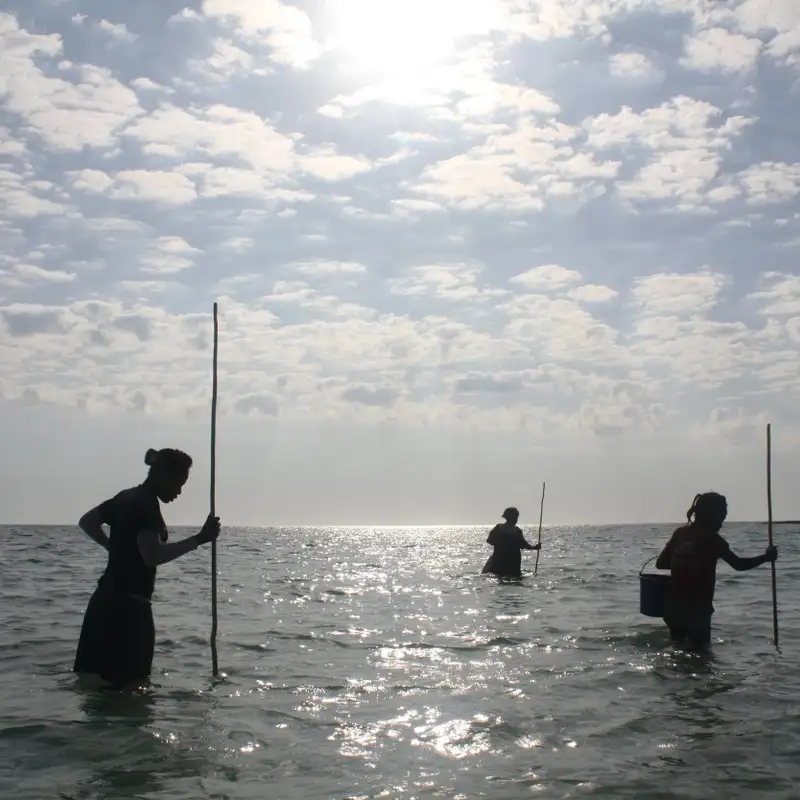
Mez Baker-Médard: I first went to Madagascar in 2002 as a study abroad student. But I returned there on a Fulbright. And in 2009 I started my dissertation research, but continued up until 2019. So about two decades of research was put into this particular book. And I spent more than 13 months living in Madagascar’s southwest, northwest, and northeast regions. And I lived with fishing families. I learned to fish on foot. I am still, despite years of practice, not that great. It's actually quite hard to find an octopus because they're camouflaged and so you can usually tell they're in their den by just their eye. But seeing their eye is something that I think the fishers are great at and I'm still not that great at. I also conducted over 92 semi-structured interviews, 889 gender stratified surveys across 19 villages, 26 oral histories with village elders. And then multiple months in the colonial archives in Aix-en-Provence in France, as well as in Madagascar looking at archival documents.
Mark Williams: So ethnographic work as well as archival work, and personal observation went into the research?
Mez Baker-Médard: And social surveys, so a mixed method approach.
Mark Williams: Excellent. Thank you. The title of your book, Feminist Conservation, suggests there's an important distinction between this kind of conservation and the kind of conservation conventional wisdom might imagine. Can you help us understand what that difference is and why you believe it's so important?
Mez Baker-Médard: There's definitely a difference, and that's the heart of the book. I think the idea is that conservation does not need to be top down, expert driven process that tells local communities what to do.
Instead, feminist conservation puts things like self-determination and sovereignty and justice upfront. It asks who gets to decide what conservation looks like, who benefits, and who gets left out. For example, a lot of the communities I worked with in Madagascar’s marine protected areas ended up excluding, or marginalizing some of the women who primarily fish on foot. They no longer had access to some other sites, their fishing sites that they had for generations. Even though those policies were supposed to be neutral, not specifically targeting women. Feminist conservation looks to address power dynamics head on. Enclosing spaces, privatizing them or making them off limits to a large number of people is going to put the power in certain people's hands and not others.
Feminist conservation also thinks about whose knowledge and what are the values and ideas and ideals that are being advanced. And so those are going to change the metrics. We are maybe not going to look at just biodiversity counts. We're going to think about medicine as well. We're going to think about economy, and livelihoods, and spiritual connections to place. There's going to be a much broader suite of metrics and values and interests that go into the decision making around that area.
Mark Williams: Let's shift gears and focus on the marine conservation programs that you write about in your book. How did these programs come to Madagascar in the first place? Who have been the main players or key actors in getting these programs going?
Mez Baker-Médard: It's a good question. Marine conservation in Madagascar has had a very layered history, and I mentioned earlier the colonial origins to some of the policies.
And in the modern era, I think, there was a period of isolation in Madagascar due to a socialist regime. After the transition, there was more of a neoliberal, outside-oriented government that took over, and international conservation funding just poured in the 1980s. And the 1990s, the country created an environmental charter and a national environmental action plan. And that was pre the 1992 Rio Summit, which is pretty amazing that Madagascar was a leader prior to a lot of the other nations in the world adopting a similar approach.
So the colonial government is a key player. Big international non-governmental organizations like the Wildlife Conservation Society, Conservation International, World Wildlife Fund for Nature Conservation. Major donors like USAID, World Bank, IMF, but also government leaders.
There's been two presidents. Ravalomanana, more on the terrestrial side a little bit on the marine side. But, president Rajaonarimampianina–it's a very long name–in 2014, pledged to triple the amount of marine protected area in the country. So there's been a long layered history, but some current players that have really shifted how conservation is carried out in Madagascar.
Mark Williams: Could I pursue with you this most recent development you were just mentioning? Was it 2014 you said? What was the impetus for this big shift, for this welcoming of, was it international aid you had mentioned?
Mez Baker-Médard: So there's millions of conservation dollars that are spent in Madagascar, but certainly by 2014 there was a shift from terrestrial to marine. And that was an emerging frontier for conservation, that they could put money and exciting programming into the marine space in the name of marine conservation, biodiversity conservation, and fisheries stabilization.
Mark Williams: Mez, could you tell us a little bit about some of the specific conservation projects that you observed while you were doing your research in Madagascar?
Mez Baker-Médard: One of my favorite spots is in southwestern Madagascar, a little bit north of a big town called Tuléar. And it's part of a large project, initiated, I think, by both World Wildlife Fund and Wildlife Conservation Society. They've established a large marine protected area there, and it's a category six marine protected area, which means multiple uses are allowed, but then within it there's also these no take zones or what would be categorized as a category two IUCN category of their levels of protection for a protected area. And so, a strict no take zone. There's smaller reserves within this larger marine protected area. And so a lot of what I would do in the area was visit villages in this larger area, which means beautiful ocean. And visit villages, talk to people about their local reserve as well as their opinions of and experience with the larger marine protected area.
And within that, there's also layers of, so it's not just spatial protection, but there's gear restrictions. There's species restrictions.
Mark Williams: Gear restrictions?
Mez Baker-Médard: Yeah, so certain types of gear was not allowed to be used in the area to harvest fish. Poison wasn't allowed. Nets under three fingers–that's how people talk about it, deux doigts, trois droigts–and so small mesh nets. And in some areas, fishing on foot was discouraged or actually outlawed. And that's the only way women fish. So if you outlaw that, women cannot fish. So I visited Soariaka often. But I think I had a total of eight zones like that. Nineteen villages within those eight zones.
Mark Williams: So there were eight sort of projects that you were observant of.
Mez Baker-Médard: Yes.
Mark Williams: How successful have these conservation programs been? Just in terms of conserving marine life and marine resources?
Mez Baker-Médard: I feel like these are such straightforward questions, seemingly, but they're actually very complex to answer. So by their own metrics, I think they've been moderately successful in some cases.
Mark Williams: Their own metrics being?
Mez Baker-Médard: The conservation organizations and governmental organizations working with the non-governmental organizations, who are seen as kind of the primary technical advisors. I think by their own metrics, they are moderately successful. Some of them they acknowledge are failures. It's a question that I actually directly ask the conservation organizations as well as the different ministries of environment and fisheries in Madagascar.
But I think what is considered moderate is actually a huge success for them if they compare their villages that have interventions to villages that have no conservation interventions. So moderately successful means that they might have stabilized the fisheries slightly. It's still declining. There’s still less and less catch each year, but it's not declining as rapidly as elsewhere. That's a win. But that is not across the board. There's some places that I would say are not just failures, but you actually see a higher, more degraded environment inside a protected area, inside a reserve than outside it.
Mark Williams: That's fascinating. Some of what you write about in the book deals with something called the Mihari Network, M-I-H-A-R-I. And I'm wondering, could you tell us what this is and how it relates to marine fishing and conservation and what impact has it had on Madagascar's marine conservation efforts?
Mez Baker-Médard: Yes, sure. So the Mihari Network, which is short for Mltantana Harena and Ranomasina avy eny Ifotony, which basically just means locally managed marine area in Malagasy. It's a national platform and it's one of the, I'd say, few organizations that is deeply rooted in coastal community associations and networks. It is supported by non-governmental organizations and governmental organizations, but they really are making a concerted effort to put front and center the needs and interests and values of fishing communities and fishing associations. And I think I like it. And I really did a lot of interviews and ended up publishing a couple papers, with some folks rooted in Mihari because I think it represents a major shift.
Mark Williams: How so?
Mez Baker-Médard: A shift from top down conservation towards more participatory, locally rooted conservation. It connects hundreds of fishing villages. So they have these big forums, sometimes twice a year.
Mark Williams: So Mihari is a network of fishing associations or fishing villages?
Mez Baker-Médard: Yes. And most villages have a fishers’ association. It's still very male dominated. But a colleague of mine, Vatosoa Rakotondrazafy, helped launch the Fisher Women's Leadership Program, along with a couple other colleagues, Marianne Randriamihaja and Prisca Ratsimbazafy. These are some folks who are part of Mihari who launched the Fisher Women's Leadership Program, who are really taking feminist principles and inserting them into Mihari. And some of them have established their own marine management zones independently from conservation organizations. So this is deeply locally led. And some of them include temporary no-take areas. And this especially is with octopus because they grow quickly and they can be harvested and they're not over extracted. There's lots of other areas they can spawn. So you actually see higher catch in temporary closed areas with octopus, and people call them octopus reserves or octopus banks even. So they can extract octopus after three-ish months and actually see a benefit.
They experience and advocate for their own rights in this network. It's something that I've published with those folks about and we're going to try to do a follow up study to look at the impact of their programming on who’s attending. But there's just some really cool stuff happening within Mihari that I'm excited about. I think the challenge though is it's a beautiful model and NGOs are generally supportive, but I think it's a slippery slope between supporting and co-opting. And that is something that I've had some conversations with some Mihari folks.
Mark Williams: Are they sensitive to that?
Mez Baker-Médard: They are, I think mostly. But it's hard to give money and say, we're going to fund you, but we're going to let you entirely decide what you're going to do with that funding. Instead of saying, here, we're going to fund you and we actually want you to do X, Y, Z. So that slippage, I've seen in some ways and they've felt in some ways and in other ways, I think NGOs have really let them lead.
Mark Williams: One thing that caught my eye in your book is the way the book uses intersectionality to analyze and explain the impact that conservation programs have had on some of the Malagasy fishers. Talk a little bit about this, would you. Maybe first tell us what intersectionality is, what it means, and then what kinds of effects it had on people who've depended on fishing for their livelihood there in Madagascar?
Mez Baker-Médard: Intersectionality. Intersecting, overlapping threads of oppression, threads of power. Kimberly Crenshaw’s often credited for coining the term in 1989. And one quote that I like from her is, intersectionality is a metaphor for understanding the ways that multiple forms of inequality or disadvantage sometimes compound themselves and create obstacles that are often not understood among conventional ways of thinking. So, women in the poorest of communities were systematically excluded from shallow water fishing areas when they became marine protected areas, that wasn't across all of Madagascar, but in certain areas.
Mark Williams: They were excluded, the women were?
Mez Baker-Médard: So there was one village that I visited, where an island offshore used to be their main fishing zone. It was nice and shallow, very abundant.
Mark Williams: And they could fish walking?
Mez Baker-Médard: Fishing on foot, and people fished on boats. So women would go over on a boat and then be dropped off and fish on foot and then get a ride home. And if the weather was bad, they'd sleep on the island. And now that's UNESCO marine protected area and it's off limits. And there's guards, armed guards that are on the island. And so in that particular village, no women fish anymore. No women fish. Their main area for fishing on foot is now within a protected area. Men can still fish from boats outside the protected area.
But that's a more extreme example of the impact of a protected area and it's disproportionate impact on women and poor fishers in that area. And I think layering on all of that is post-colonial dynamics and kind of inter-ethnicity dynamics between highlanders and coastal people, between foreigners and Malagasy that also influence access.
You can look at it within a community, but then we also have to scale out and say, there are power dimensions, there are power dynamics that are influencing who even gets to make the decision in the first place. And not just where the protected area is going to be located, which might be more of thinking about gender at the village level, but then is a protected area even something we want?
Mark Williams: And that’s a decision that is made elsewhere, perhaps?
Mez Baker-Médard: Which has ethnic and political, geopolitical dynamics that also intersect with more traditional identities of gender and class and education status, et cetera.
Mark Williams: If intersectionality has disadvantaged some Malagasy fishers, how have those who have felt the cost of intersectionality, how have they responded to this?
Mez Baker-Médard: Again, great question. In many different ways. I think I just mentioned that women have stopped fishing in one of those villages. So, maybe resignation is one reaction. Another reaction is active resistance.
Mark Williams: What form does that take?
Mez Baker-Médard: Well in one of the villages that I stayed in quite a while, I would fish on foot with women in the intertidal zone, right adjacent to shore. And one night, my host mother said. “Do you wanna go fishing?” And it was like 9:00 PM. I said, “sure, you mean tomorrow?” And she said, “No. Now. Get your kapa.” These sandals made of tires to protect your feet. “Get your kapa and let's go.”
And so I got my little bucket, I got my kapa, I got my spear and got into the boat and I think, are they playing a joke on me, what's happening? But we went out to the reef crest inside protected area and fished by full moonlight in the no-take zone. I wasn't very good at it, but it was a low tide at that moment. I think I got like one sea cucumber, you know, the sessile organism that does not move. That's what I caught, but they caught other things that evening.
Mark Williams: Did you get the impression that this is a practice that they did more or less routinely?
Mez Baker-Médard: I'm not sure how routinely, because ecologically, it has to be timed with low tide, full moon, and nighttime low tide. Clearly it's not the first time they had done it, but I'm not sure how routine it is.
Mark Williams: It's interesting to think about the extent to which the conservation programs create incentive structures that motivate people to support and obey the rules or incentivize them to disregard and break the rules.
Mez Baker-Médard: I've seen things that I would consider to be nowhere close to an incentive become incentives. Like I mentioned earlier, t-shirts and getting a football for your local team that can play in a tournament against other villages that the conservation organizations are hosting in a really brilliant way to incentivize people to participate in the ways they want them to participate in conservation. And rides to other villages, rides into town, and per diems, which conservation organizations would say this is just a minimum amount of payment to compensate for you spending time away from fishing. And fishers would call them their salary, Karama. And I'd go, Ooh, that's a really different way you guys are understanding the same money. And they'd even negotiate about their Karama, their salary. They'd say, we want more Karama, salary. And they'd say, well, we can increase your per diem slightly.
What is considered an incentive. Conservation organizations thought about that as minimal compensation, and fishers thought about it as a benefit of the conservation project. So, incentives took a lot of forms, and I think I naively as a budding kind of conservation biologist, as an undergrad, thought people would want to do this for themselves just because that is the right thing to do and it'll always improve their lives.
Mark Williams: So Mez, you've talked about international conservation groups have played a key role in Madagascar's conservation programs. And that sort of raises a question in my mind of what you actually think about these external actors. If some of the groups, for example, that are working in Madagascar, if they were to hire you as a consultant so that you could make their operations more successful, what kind of advice or perhaps constructive criticism would you offer?
Mez Baker-Médard: I have been hired by some of these conservation organizations, and it's much harder to critique within. It's much easier to critique from a removed position. So in my final chapter of the book, I try to lay out these principles, guidelines that you can follow, even though they're heuristic, they're not trying to be prescriptive.
I think the biggest one, and I actually think it's the hardest one, is trust local knowledge. And center local cosmologies, local worldviews. I think that's the hardest.
Mark Williams: Trust local knowledge. And
Mez Baker-Médard: Center local worldviews. So what we consider, okay, we're coming in with a protected area, where do you want it? That might be a participatory way of engaging the community. We're conservation organizations. We want to put in a protected area. That assumes protected areas are the correct thing to do. That assumes that is something that's going to benefit and that local people want. So you could be quite participatory. Where do you want this located? It's up to you where, but this is what we're doing.
But local cosmologies, I think might be that we need to restore, for example, taboos in certain areas. They're no longer respected by the younger generation. If we respect ancestral customs and taboos, then the fish are going to respond to that in a positive way. It's a very different way, different worldview than, put a protected area, to let's think about how we've upset spirits in the ocean. Why the gods are mad, and what can we do to repair those social spiritual relations in our village as well as in the region, or even the country, or even Western perspectives might not have the best answer. And it takes a very different kind of framework and way of thinking to even be open to that. But that's the first thing I would do. Also, maybe rethink enclosure as the solution to unsustainable behavior.
Mark Williams: And so, when you say rethinking protected areas. Rethinking?
Mez Baker-Médard: Maybe protected areas is, I think it's a band-aid solution to broader structural drivers of degradation, of environmental degradation, and what I would argue is also social degradation. So maybe go home, conservation organizations. Look at how your home countries are contributing to the environmental and social degradation happening elsewhere. I don't know if I’d say, actually leave, because I think there's benefit, probably, to having people who are internationally situated, conversing with each other and working together. But, look at the structural drivers on sustainable consumption, climate change. We're talking about reefs being destroyed because of ocean acidification, strong storms, and warming seas. And you're not addressing that. Instead, you're going to say, stop fishing on foot.
I call it the politics of the low hanging fruit. It's much easier for conservation organizations to control a population here than say, oh, how am I involved? How are the people who I'm asking for donations involved?
Look at trade policies, predatory fishing policies that say, we're giving these licenses to these countries to just extract all you want at a really low cost. But meanwhile, demonize small scale fishers. We're eeking out a livelihood. So no more politics of the low hanging fruit; address those structural drivers.
Mark Williams: You said that you found it more difficult to critique an organization from within. What did you mean by that? Without divulging any trade secrets or anything that you shouldn't divulge. What did you mean by that?
Mez Baker-Médard: I have interviewed hundreds of conservation organization personnel, and I've worked for conservation organizations. There are a lot of really well-intentioned, thoughtful, smart people working in conservation. And I don't think it's any particular person's fault. I think there's some probably bad eggs in any organization, but I don't think it's any one person's fault or even an organization. They have their mandate; it's broader structural drivers that they're working within.
They're working within kind of a broken economic system, global economic system. They're working within challenging political systems that make really addressing those upstream kind of structural drivers hard.
The positive thing is, I don't think any one of these conservation organizations have a lot of malicious intent. Like I, I feel lucky to be studying where there's a lot of goodwill. It's just, dealing with some just very challenging, I keep on saying it, structures.
Mark Williams: Well, these are exogenous factors, these are factors that it would take more than a program in a couple of villages to actually deal with. You know, they are much broader than what some of these groups probably are capable of tackling effectively.
Mez Baker-Médard: And yet, that's what's needed.
Mark Williams: Well, finally, Mez, what might be two or three of the main findings from your research on Madagascar? What conclusions did you reach, and could your findings, you think, have broader implications beyond Madagascar itself?
Mez Baker-Médard: The main findings are trust local knowledge, and really center local worldviews. I think Westerners might not have the best ideas about how to address fisheries decline, climate change, biodiversity loss. I mentioned resisting enclosure. And I think that pertains well beyond Madagascar. Stop creating fixed spatial closures that disproportionately affect certain populations, and in my case, women and poor fishers.
There's a scholar I really like Sylvia Federici, who talks about reestablishing the commons as an antidote to the way in which neoliberal policies tend to privatize and enclose resources that should be really shared by the public. And then I think the biggest one, which we ended with, which is address upstream drivers. No more politics of the low hanging fruit, no more addressing hyperlocal issues that are more of an outcome of broader systems that need to actually be addressed at their root.
Maybe it's a little vague, but I think those really do apply to many, not just, fisheries issues, but conservation issues and thinking about environmental degradation writ large.
Mark Williams: Okay. Thank you very much. It's been a pleasure speaking with you, Mez. Thank you for being a guest here on New Frontiers.
Mez Baker-Médard: Thank you so much for having me. I feel honored.
Mark Williams: This episode of New Frontiers was produced by Margaret Defoor and me, Mark Williams. Our theme music is by Ketza. If you like the show, leave us a rating or review on Spotify, Amazon, Apple Podcasts, or wherever you get your podcasts. This can help others to find us too. We'll be back with another episode of New Frontiers. Thanks a lot.