High Seas Research: Decoding Earth's Climate Past
Charlotte Tate: From the Rohatyn Center for Global Affairs at Middlebury College, this is New Frontiers. I'm Charlotte Tate, the Center's associate Director. In this episode, Mark Williams sits down with Allison Jacobel to discuss how scientists study our planet's climate history, use proxies to assess the impact of climate change and experience the challenges and rewards of months long research on the high seas.
Mark Williams: Have you ever wondered what Earth's climate might have been like in the past? How it might have changed and what the past might tell us about our climate future? Have you ever wondered how we humans actually learn about the past?
After all, today's scientists still don't have a time machine, so how do they get accurate data about the past? And how does this data help us understand the planet's climate trajectory? Here to discuss these things with me is Dr. Allison Jacobel, an Earth and climate scientist, Assistant Professor of Earth and Climate Sciences and a faculty fellow with the Rohatyn Center for Global Affairs here at Middlebury College.
Her expertise is the study of the earth's climate, particularly its past. She's co-authored a slew of academic articles, including publications in such esteemed Scientific Journals as Nature. And as a faculty fellow, she co-directs the Rohatyn Center's program on Science, Technology, Environment, and Global Affairs.
Allison Jacobel, welcome to New Frontiers.
Allison Jacobel: Thank you so much for having me.
Mark Williams: We're really glad you're here. What exactly is an earth and climate scientist? Could we start with that question? Tell us a little bit about your research.
Allison Jacobel: I am super interested in understanding Earth's climate, past, present, and future. And so in order to understand the climate system, we really have to understand the earth system as a whole. How earth processes act to move carbon between different reservoirs on the surface of the earth, how energy is transformed. I did my undergraduate degree at a small liberal arts school, much like Middlebury. And I have a degree in geology.
And then I decided that I wanted to narrow my focus to think about records of climate and carbon storage as recorded by the ocean, the marine sedimentary record. I went on to get a PhD in geochemistry from Columbia University, and then came to Middlebury.
Mark Williams: Excellent. So, you studied the Earth's climate. Is this the type of research you can do in a laboratory or do you have to go out into the field to conduct your research?
Allison Jacobel: Yeah. One of the things that I love about this work, is that it involves all different kinds of research spaces. So, being out in the field, I've been incredibly fortunate to go on a number of different research expeditions all around the world.
There is also a lab component to my work and also a modeling component. One of the things I love about it is that I get to sample a little bit of everything
Mark Williams: Indoors and outdoors. Absolutely. So that brings us to the research cruises that seem to be an important part of your academic research. And as I understand it, these are research cruises that can last sometimes several months. There's so many things that I'd like to ask you about these cruises, but let's start with an obvious question. Why do you have to go out to sea? On these types of expeditions to conduct your research?
Allison Jacobel: It's a great question. I like to tell my students that the continents are sites of erosion. We have these mountains that are constantly being weathered and worn down. If you want a long, continuous record of what's been happening anywhere on earth, on the land or in the oceans, the oceans are actually the best place to go to get a record of that history.
We can think of them as these sort of giant bathtubs, that are constantly accumulating sediment over time, that reflect all the changes that earth's climate has undergone. If we want those long, continuous records, the oceans are really where we should go to obtain them.
Mark Williams: That's really fascinating.
I'd never thought about it like that before. The data that you would get from research in the oceans, is it more intact than what you would find on land? Is it substantively different?
Allison Jacobel: It's a great intuition, because of the erosive processes on the surface of the land. And the ocean is more protected, by virtue of the fact that it has this thick layer of water on top of the sediment. The record does tend to be more continuous and the accumulation rates are also more constant, which helps us when we're trying to think about telling time in the geologic record. We don't have some of the gaps or the really abrupt changes in the rate of recording that you might have on the surface of the land.
Mark Williams: So the tides and the waves and so forth, they don't really disturb as much as one might imagine the actual sediment below?
Allison Jacobel: So most of the records that we're obtaining from the oceans are way out in the middle of the ocean basis. So, yeah, your question about going out to sea specifically for multiple months at a time really reflects the fact that we have to get quite far away from these very dynamic processes that you're describing in order to get these intact well-preserved records.
Mark Williams: Spending months out on the high seas, which is so different than the short luxury tourist cruises many people enjoy these days, made me wonder about the size and composition of the research teams involved in these expeditions. I put this question to Allison.
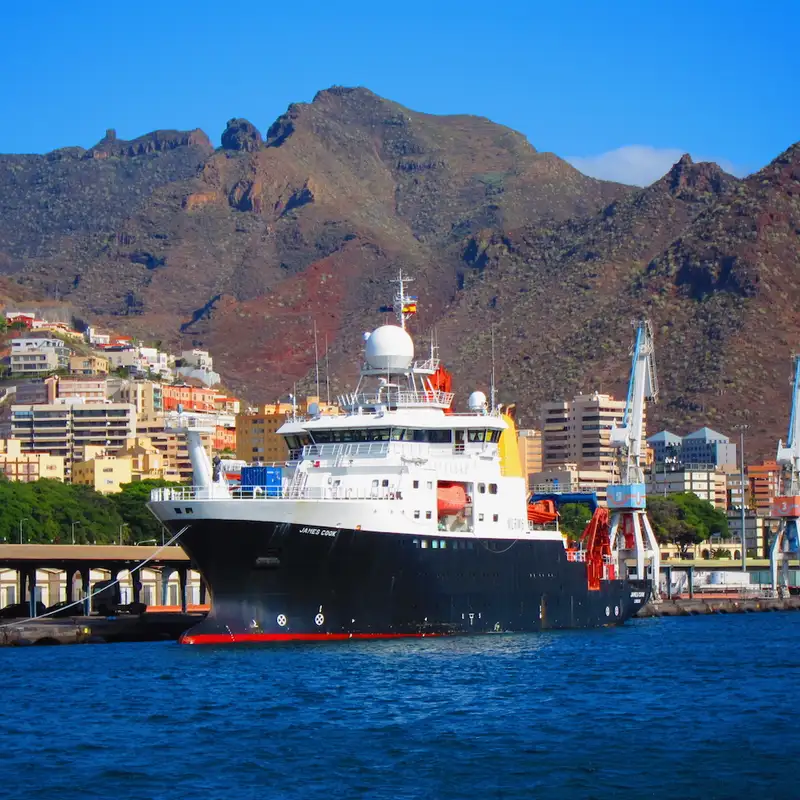
Allison Jacobel: It depends a little bit on the ship that we're going out on. The most recent cruise that I was able to take a Middlebury student out on, was on a ship that's owned and operated by the Irish, called the RV Celtic Explorer.
That's about 200 feet long. We had about 15 crew and about 20 scientists. But I think your question might be more about like, who is out on these.
Mark Williams: Who is out, who is part of the research team? I'm assuming you're not working alone when you go out on these cruises.
Allison Jacobel: Yes. Very fortunately not.
And that's one of the things that I love about these expeditions. As you might imagine from the fact that this most recent cruise was on an Irish ship, the research team is incredibly international. So we're pulling expertise from really all around the world. And that is part of what's exciting is that you are hearing these perspectives from people who study very different environments and very different subjects than your own.
So not just do we have a diversity of scientists, in terms of nationality, but we're also pulling together research teams that involve geochemists like me, biologists, oceanographers and sort of the classic sense people who study the physics of the ocean. It's really just amazing to be in proximity to all of these different perspectives, in terms of what's going on in your immediate surroundings and what's going on in our world.
Mark Williams: It sounds like a very kind of dynamic group once it's assembled. Can you describe what the life of a marine researcher is like when you're out at sea for so long?
Allison Jacobel: Absolutely. So we often refer to them as research cruises and that's a little bit misleading. This is not your grandmother's carnival cruise. The expeditions that we go out on are hugely expensive, both in terms of financial resources, as well as the carbon footprint of being out on a research vessel for so long. So we really have to make every minute count. We have operations going on the ship 24 hours a day, seven days a week, for the entire duration of these expeditions.
Mark Williams: So this is not an eight-hour work day when you're out on the ship.
Allison Jacobel: We wish by the end of it. We are definitely ready to go back to that. So the particulars of the shift work varies from cruise to cruise. But again, this most recent expedition that we were out on, we had shifts from noon to midnight and midnight to noon. You often will share a cabin with somebody who's on the opposite shift.
So you sleep when they're working. I see. And they're asleep when you're working. We're trying to optimize. Every day is jam packed with something different. Every participant is involved in every aspect of the research process. It doesn't matter if you're a geochemist, you're out there helping the biologist to sort the organisms that we've brought in the dredges or off of a remotely operated vehicle.
There is absolutely no downtime.
Mark Williams: It really does sound, not just intriguing, but it sounds exciting. Oh, yes. The kind of work that you're conducting.
Allison Jacobel: Yeah, absolutely. I mean, don't get me wrong, in real time, it is utterly exhausting to be going continuously for sometimes months at a time.
But the work is so exciting and to be part of making meaningful contributions to not just your own research but also somebody else's research. Just really helps keep the adrenaline going and the motivation strong.
Mark Williams: Thank you. You had mentioned that you were able to take a student with you on one of the recent cruises. What's a typical day like for a student who's part of this team?
Allison Jacobel: As you might imagine, because the science party is so small and because the ship time is so valuable, the research assistants are doing absolutely the same work that everybody else is engaged with. And that means there's a lot of learning on the job.
So learning by watching, learning by doing, making mistakes. Mm-hmm. And being gently corrected because there's no time for standing on the sidelines. And again, that's one of the really fun things about these cruises is, people need you and they want you to be involved in every aspect of the research process.
So you get exposure to a lot of things that if you were to stay on land, you might never get to be involved in. That participatory feeling and the need to pull together is one of the really great things about these cruises
Mark Williams: Are the students also on the 12 hour shifts?
Allison Jacobel: Yeah. They are just like everyone else. Yep. Absolutely. When I was out most recently, my research assistant and I were on the same shift. We work for 12 hours and then typically there's a couple hours before we go to sleep and there are lots of resources for fun and relaxation on the ship.
So we work hard but there are often, on these ships also like a movie room. On this most recent cruise, we actually watched all of Game of Thrones from start to finish in our hours off. So there is absolutely time for fun. There's time for exercise. One of the wonderful things about the cruises is that they feed you so you don't actually have to worry about cooking for yourself. Meals are sort of put in front of you. There's a lot of very hard work but really it's set up for success.
Mark Williams: That sounds wonderful. Could I ask, given that your last cruise ship was an Irish vessel and an Irish crew, how do you go about securing the vessels for your research?
Allison Jacobel: We have international collaborators all around the world, so I've been incredibly fortunate. My most recent cruise was out with the Irish. Before that I did two cruises with UK researchers. My very first cruise was on an American ship. But the research community is incredibly international and especially in the interest of North Atlantic research.
We have all of these participants from countries that encircle the North Atlantic and we're all interested in the same research questions. So it really behooves us to collaborate and to share expertise and in the case of the ships to share resources.
Mark Williams: Who books the ship? How does that work?
Allison Jacobel: Typically the cruises have a chief scientist, so that's the person who's responsible for integrating all of the different aims of the scientific party. They typically get together a year or two in advance of the cruise and bring together these scientists and their different interests, and they put together a cruise proposal. So they describe how many days we're going to be out, where our sampling locations are going to be. And how the aims of all of these individual scientists are going to be collectively served by this expedition. And that goes into a pool that's very competitive.
So proposals from scientists who are interested in using that same ship and that same time. So it's a very competitive process. And when one is awarded, when a cruise sort of gets the green light, the rubber hits the road and everybody is just single-mindedly focused on making it happen.
Mark Williams: Now if you're listening to this and are wondering how common it is for undergraduates to participate in a research expedition, like the type Allison's describing, the answer's clear. It's not common at all. Graduate students, yes, but undergraduates, hardly ever. And yet when it does happen, what an amazing experience for that student.
As Allison explains, she believes that experience can be so rewarding, she wanted to ensure her undergrad research assistant could share in it. I think that's great.
Allison Jacobel: So I was a little odd on this most recent one I made my participation in the cruise contingent upon having the opportunity to bring an undergraduate with me, because I think they do phenomenal work and I thought it would be a really good opportunity for a student.
Mark Williams: What do you do when there are storms at sea?
Allison Jacobel: We have to ride them out. If it looks bad, we'll try and escape. So we'll sort of, you know, go off route, maybe try and get outside the area of maximum wind stress. But it gets rough out there.
Mark Williams: Allison, when you think about these expeditions, what's proved to be the biggest challenge in doing science at sea and what's been the most rewarding aspect of doing this?
Allison Jacobel: I am so glad that you asked this question because I think, oftentimes, we focus on the benefits and the really exciting parts of doing field work. But there are absolutely challenges. And for me, when I'm out at sea, those are pretty significant. So I get violently seasick. I have thrown up so hard for so long that I've had to take electrolyte tablets to reestablish hydration.
I give myself black eyes from the force of, you know, getting rid of things over the side. So the seas can be rough. Everybody experiences their own challenges when they're out at sea. For me, that's a pretty significant obstacle., usually passes after three or four days. But I am definitely, I'm not the most ideal person to go to sea with.
Mark Williams: Oh my goodness. Oh my goodness. You are reminding me of a time that my mother and I and some other relatives took a boat to go whale watching. And I was afraid of getting seasick and my mother was as well. And so we both took some Dramamine. And by the time we got to where the whales were, my mother and I were both asleep.
With our heads bowed on the table. And my wife kept shaking me, “Honey, come look. The whales are breaching. The whales are breaching.” And I couldn't raise my head at all. I didn't see a single whale. My mom didn't see a single whale. We woke up at shore.
Allison Jacobel: Yeah, yeah. Back on land. Oh, I sympathize. I have tried every over the counter, every prescription drug that has ever been prescribed for nausea of any kind, seasickness or otherwise. I struggle to find things that work. So I know that this is a thing that's going to happen to me when I go out to sea. And it is something I just have to overcome. The other part of your question is, what makes that worthwhile?
Mark Williams: What's the most rewarding aspects of that research?
Allison Jacobel: You know, I say yes every time because I know that there's going to be these three or four days where I'm going to be absolutely miserable, maybe more.
But it is absolutely spectacular to be out on the water. It's so dynamic. I mean, one day it can be incredibly peaceful and placid waters and you're sort of moving gently between these gleaming icebergs. And the next day, a storm has blown in and the ship is heaving and you're heaving and you're just struck by the awesome power of the ocean. And it makes you feel small and insignificant. It's an incredible experience. I've never experienced anything else like it and I love it.
Mark Williams: Thank you so much. How did you get interested in studying the Earth's climate to begin with? What led you into this field of study as opposed to computer science or literature?
Allison Jacobel: So I was incredibly fortunate. When I was in second grade, I took a trip with my family to the Great Barrier Reef in Australia and. As you can probably tell from my general sense of being mesmerized by the ocean, I was just blown away by the beauty of the Great Barrier Reef and the biological diversity of organisms, and the interconnected nature of the ecosystem.
And I was just enraptured. The more that I learned about the reef, the more I learned about the impact that anthropogenic warming and CO2 emissions were having on the reef. And it just broke my heart. I wanted to do something that would enable me to understand and hopefully, ultimately to help.
Mark Williams: Thank you. Let's shift gears and focus on the most recent expedition that you've been speaking about. Where did that particular cruise go and what kinds of data were you seeking? And finally, what kinds of questions were you looking to address by gathering that data?
Allison Jacobel: So we were out at sea for 30 days. We left from a small fishing town in Ireland called Killybegs on the northeastern part of the coastline.
From there we went north. Up, up, up to just south of Svalbard, so like 75 degrees north. From there we went over to the east coast of Greenland and then down along the margin, which is where we saw the gleaming sculptures of ice, the icebergs. Then we came back over towards Ireland, just south of Iceland, and docked in Galloway, Ireland.
It was one of the most spectacular research cruises that I've been on. Just extraordinary scenery. And much closer to land than I typically am which makes for much greater diversity of wildlife. And the proximity to the ice. So we were doing a ton of things out there.
We were taking water samples, plankton toes, where we drag a net through the surface of the ocean. And then key for me, were the sediment cores. We essentially put like a big PVC tube with a whole bunch of weight, like three tons of lead weight. We lower it down to the sea floor and then we drop it.
Then when it comes back up, it's full of sediment. And that's really the focus of my research. We're sort of looking with that diversity of different sampling techniques, to understand modern climate. So what's happening in the region at present. We really want to use environmental samples from today and compare them to modern climate. So temperatures, salinity, nutrients. And to understand the relationships between the environmental variables that we see today and the chemistry of the organisms that we see today.
Mark Williams: Can you unpack that more for listeners who are not earth and climate scientists or earth and climate majors?
Allison Jacobel: Absolutely. So my favorite way of thinking about this is, if you look outside your dorm window and you see people with umbrellas, what do you know is happening?
Allison Jacobel: It's raining. Yeah, absolutely. So in that case, an umbrella is a proxy for an environmental variable, in this particular case, rain. What we're looking for are proxies that help us understand past environmental conditions.
And you can sort of start to understand the complexity of this. If I ask you what you might think, if you saw a landfill, which is really the sedimentary record. And if it was a landfill that was strewn with umbrellas, what would you think?
Mark Williams: Uh, there had been a lot of rain.
Allison Jacobel: Yeah. So there had been a lot of rain. And/or do you throw your umbrella away every time it stops raining?
Mark Williams: No.
Allison Jacobel: No. So oftentimes the reason that we might throw an umbrella away is because there's rain and wind. So the wind has caused the umbrellas to be damaged. Or you might throw an umbrella away if it had rained a lot and somebody told you it was never going to rain again.
So there's a bunch of different things that an umbrella in the sedimentary record might indicate. And our job as geochemists is to try and understand what the chemistry of organisms tells us about the environmental conditions in which they grew. We're trying to figure out when we see umbrellas in the sedimentary record, does that mean rain? Does that mean wind? Does that mean a cessation of rain? And so we need modern environmental data and modern observations of organisms' behavior to try and understand what they're telling us in earth's past.
Mark Williams: So let's set the umbrella analogy aside and talk about perhaps a specific example of what actually do you find in the settlement that you could assess and infer about the same way that one might do with an umbrella?
Allison Jacobel: So my work focuses on these tiny organisms that grow in the surface of the ocean. They're called foraminifera. They are tiny phytoplankton and they make shells in the surface of the ocean by combining calcium and carbonate. So they are basically chalk organisms.
And when they're building their skeletons, they sometimes accidentally incorporate other elements that are abundant in seawater. So, for example, they oftentimes will incorporate magnesium as a substitute for calcium. And the rate at which they incorporate that magnesium turns out to be a function of the temperature of the sea water that they grew in. So when they have more magnesium, that tells us that the water temperature was warmer.
Mark Williams: I see.
Allison Jacobel: We can use the relationship that we've observed between modern forams and modern sea surface temperatures to create these calibration relationships that we can then apply to forams that lived hundreds of thousands of years ago.
To reconstruct what ocean temperature looked like we do something very similar for ocean nutrients. We can learn about the pH of the ocean from these tiny organisms. There's a huge wealth of environmental information and I like to think of my job as a geochemist, as sort of reading the sedimentary record. But I can't just read it in a language that I am familiar with or that most people are familiar with reading. My job is really to translate this language that the foraminifera speak into a sense that's understandable to everyone.
Mark Williams: That's really interesting. Thank you. It really is.
Allison Jacobel: Oh, wonderful. That's always my goal.
Mark Williams: Perhaps you've already started to answer the question I'm about to ask but we'll give it a shot. Can you talk a little bit about how understanding the planet's past, its climate past, can help us understand the current climate crisis?
Allison Jacobel: Yeah. So I think understanding the Paleo record, these pages of the book that the sedimentary record represents, are really important for giving context to our present moment.
The climate record tells us about what earth has looked like in the past, what have been the coldest times, the warmest times, what typical rates of change are, and what natural patterns of variability look like. And so if we can understand what's sort of normal or part of earth's history and the absence of humans, we can better contextualize our present moment and humans' role in it.
Ultimately, what much of my work is aimed at doing is not just understanding what the temperature was like a hundred thousand years ago, but what the processes were that moved us from a glacial climate when Vermont was covered by a mile of ice 20,000 years ago to today. And if we can better understand those mechanisms and those processes, we can better understand where anthropogenic CO2 emissions are likely to take us in the future.
Mark Williams: Allison, based on the research that you and your colleagues do about the Earth's climate past, what should we be expecting regarding its current climate or perhaps its future climate?
Allison Jacobel: Yeah, that's a great question. So a lot of people say, earth's climate has always been changing, and that's very true. We have these cyclic patterns of interglacial, like the one that we're in right now, these warm periods and glacial periods. And actually based on the drivers of Earth's climate, we should be headed for another ice age right now. So, as you know, we are far from that in our present moment. CO2 concentrations haven't been this high for somewhere between three to 5 million years.
So we are well outside of the normal range of variability. The last time CO2 concentrations were this high, the average temperature of the earth was about four and a half to seven degrees Fahrenheit warmer. And sea level was somewhere between 20 and 80 feet higher than it is today. So we know that what we're experiencing right now is not part of earth's natural variability.
And based on reconstructions from Earth's past, we can make some predictions about what temperature and sea level might look like in the near future. But we need more research to understand rates of change and really the full magnitude of the impact that we're having on our planet.
Mark Williams: So more research to understand how fast the change might actually happen, when we might actually see deterioration.
Allison Jacobel: We are much better at reconstructing things like average temperature. Which is much less relevant to a human than the frequency of hurricane strikes or of extreme flooding events like we saw a few years ago in Vermont.
In order to better understand what climate is going to look like on a local scale, we need much, much more data and information. And it’s really critical for a lot of the resilience efforts that we're attempting to combat the worst consequences of climate change on a local scale.
Mark Williams: You know, I listened to you talk about the kinds of data you study and I think about the immense problems that climate change can pose and it almost seems overwhelming. How do you maintain a personal sense of energy and purpose, and even commitment to your work?
Allison Jacobel: Yeah. That's a really wonderful follow up question because what I just described is some pretty depressing data about where we're likely headed. And that's something I often feel in the classroom. I teach an introductory course called “Earth's Oceans and Coastlines.” And a lot of the changes that we're talking about are really disheartening and can cause a lot of what is increasingly being recognized, as climate grief.
So, being able to maintain a, a sense of energy and purpose is really important. It's absolutely something that I struggle with. But I keep coming back to the fact that this is really deeply fascinating science to me. I have a really insatiable desire to learn more about these past worlds and what they looked like and what they can tell us about our future. And I also find working with students in the classroom really rewarding. I take some comfort in knowing that the person who figures out how to pull CO2 out of the atmosphere and sequester it in geologic reservoirs could come from my very next class. So it's incredibly important to communicate the work that we're doing to make it accessible to students and to support them as they go forth and help to create the climate solutions that will combat this crisis.
Mark Williams: Well, that sort of brings me to my next question. If we could go back to the students that accompany you on these research cruises, once the trip itself is over and everybody's back on land, do the students keep working on that particular research project or is their participation over?
Allison Jacobel: Yeah, work is just starting. So we have a lab here on campus at Middlebury in BiHall. It's called the facility for Oceanographic Research at Middlebury. The acronym for that is 4M after the foraminifera that we just talked about. We have sediment in the lab right now from somewhere between maybe three to four different research cruises, including this most recent cruise to Greenland.
We have a couple of big National Science Foundation grants that fund that work, including the participation of students who are absolutely critical to understanding the sedimentation rates and the environmental information that really allow us to make sense of these sedimentary records as pages of a story about earth's climate history.
So I usually have two to three research assistants per semester, two to three per summer. I'm still working on sediment cores that I collected during the first year of my own PhD. So there's lots of work to be done. I just had a conversation yesterday with a student who has done a little bit of work on the cores from the North Atlantic and is going to do a yearlong senior thesis with me next year. So there's lots of opportunities. You don't have to go out on one of these research cruises in order to make good use of the sediments that we collect.
Mark Williams: I was just going to ask, do some students perhaps have a senior project that grows out of some of the research that was conducted on these cruises?
Allison Jacobel: Yeah, absolutely. My student Ella, who's done some work on understanding the chronology or basically the relationship between depth and the sediment and the age or time period that represents, is going to be continuing some of that work looking further back in time. But also doing some new work to try and understand what productivity has looked like in the North Atlantic during some very abrupt climate change events that we observe in Earth's past. And that may be a useful analog for understanding where we're headed next.
Mark Williams: Oh, I see. Staying on the topic of the students, many students today are worried about climate change. They see the impact it's already having, more violent storms, more property damage, more erratic weather. They're concerned about the environmental and economic and social change that it could produce down the line. Do you have any advice for them and for anyone? Old people like me, for example, who'd like to take some kind of action to help address climate change and try to mitigate or avoid the damage that could come.
Allison Jacobel: I think about this a lot in the student context. Mostly because I work with undergraduates every single day and I see the emotional impact as I've said, that these data have on students. And I see a lot of frustration in the classroom. These students care deeply about the environment and they're looking for guidance as to how they can help make a difference. So a lot of people in positions of power will tell young people to vote or donate. In my experience, these students are already voting their conscience. And to be frank, they don't really have very much money to donate. They don't own homes they can install solar panels on. They're living oftentimes in cities where they don't need cars. So I think that advice is often frustrating and I think it contributes to a lot of the feelings of helplessness that I see in students.
So my answer to the question really focuses on the career stage of the students, which is that they are at this incredibly important juncture in their lives. They are deciding what they want to do with their careers. They have so many important things that they can do. They can choose to reject careers and ways of life that emphasize consumption and greed and exacerbate inequality. They don't have to be climate scientists. There are so many ways to do meaningful work.
The sort of philosophy or philosophical approach that I often mention to students comes from actually Japanese philosophy. It's called Ikigai. And it was popularized by Dr. Ayana Elizabeth Johnson, who was our commencement speaker here at Middlebury a few years ago.And what it describes is these overlapping spheres. It's what you love, what you're good at, what will make a difference, what will allow you to make a living. And really in my mind, the work of being a student at a place like Middlebury is figuring out how those spheres overlap. And how they can choose a career that is squarely at the center of their personal circles. So students have a real opportunity to contribute to making the world a better place. Whether that's helping to implement climate smart policies, design engineering solutions, support resilient communities or help people who are experiencing climate injustice. So I ask my students, and I know it's a big ask, but to make really a lifelong commitment to combating the climate crisis by choosing careers that will do good. I think that's the best way to make a significant and long-lasting impact. It's much more meaningful than recycling or making purchasing choices as a consumer. And these students are really ideally positioned to do that. We have so many incredible resources here at Middlebury for helping students to find the intersection of those spheres and to really help set them up for success and to do good for the planet. So, I hope they take me up on that.
Mark Williams: Well, this has been a really fascinating conversation. I really appreciate you stopping by and visiting us here on New Frontiers. Thank you very much, Allison.
Allison Jacobel: Thank you so much for having me. It's been a real pleasure.
Mark Williams: This episode of New Frontiers was produced by Margaret Defoor and me, Mark Williams. Our theme music is by Ketsa. If you like the show, leave us a rating or review on Spotify, Amazon, Apple Podcasts, or wherever you get your podcasts. This can help others to find us too. We'll be back with another episode of New Frontiers. Thanks a lot.